LJ PERFORMANCE — PRO SERIES
If you saw the post this week, this is the part that didn’t fit in it.
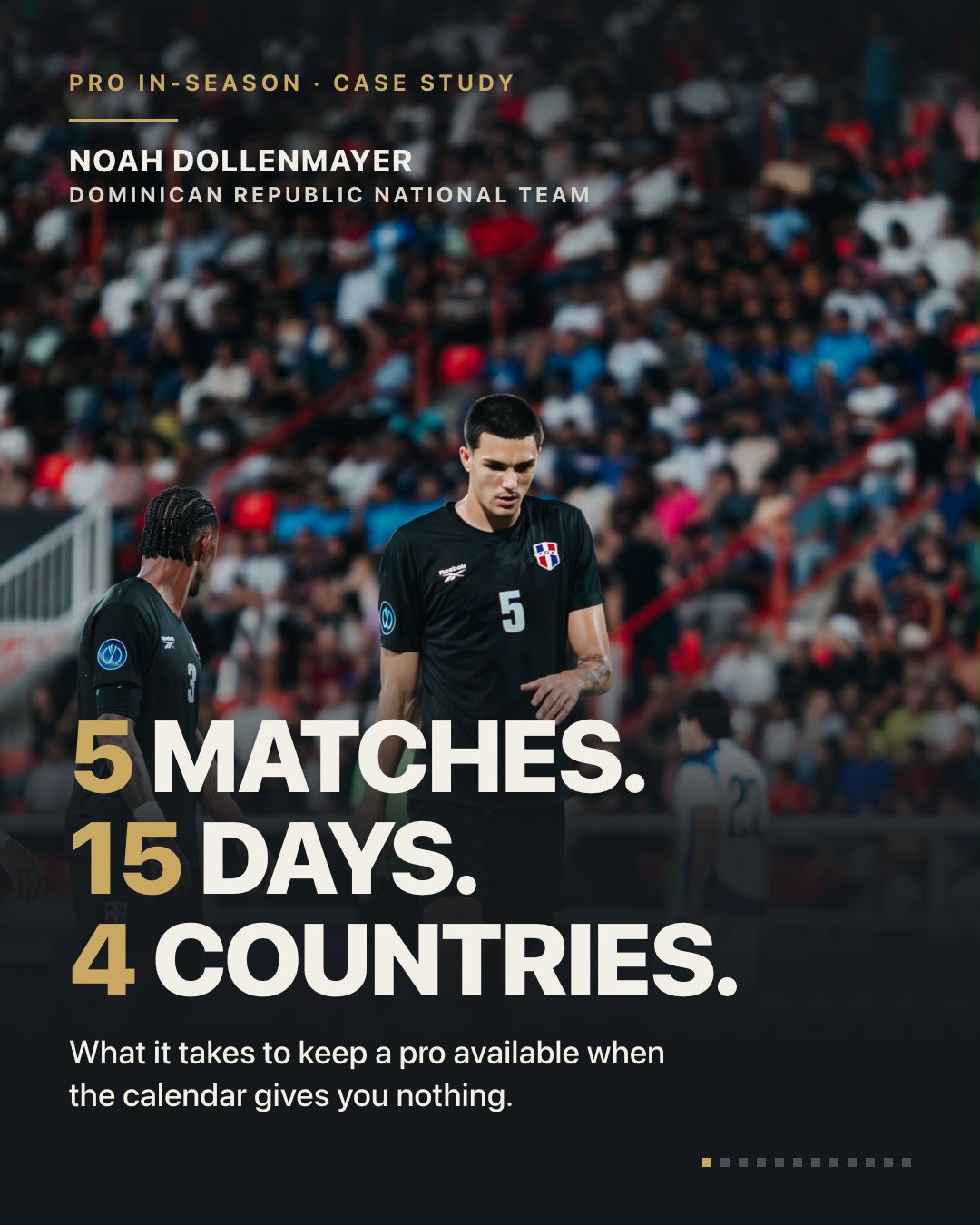
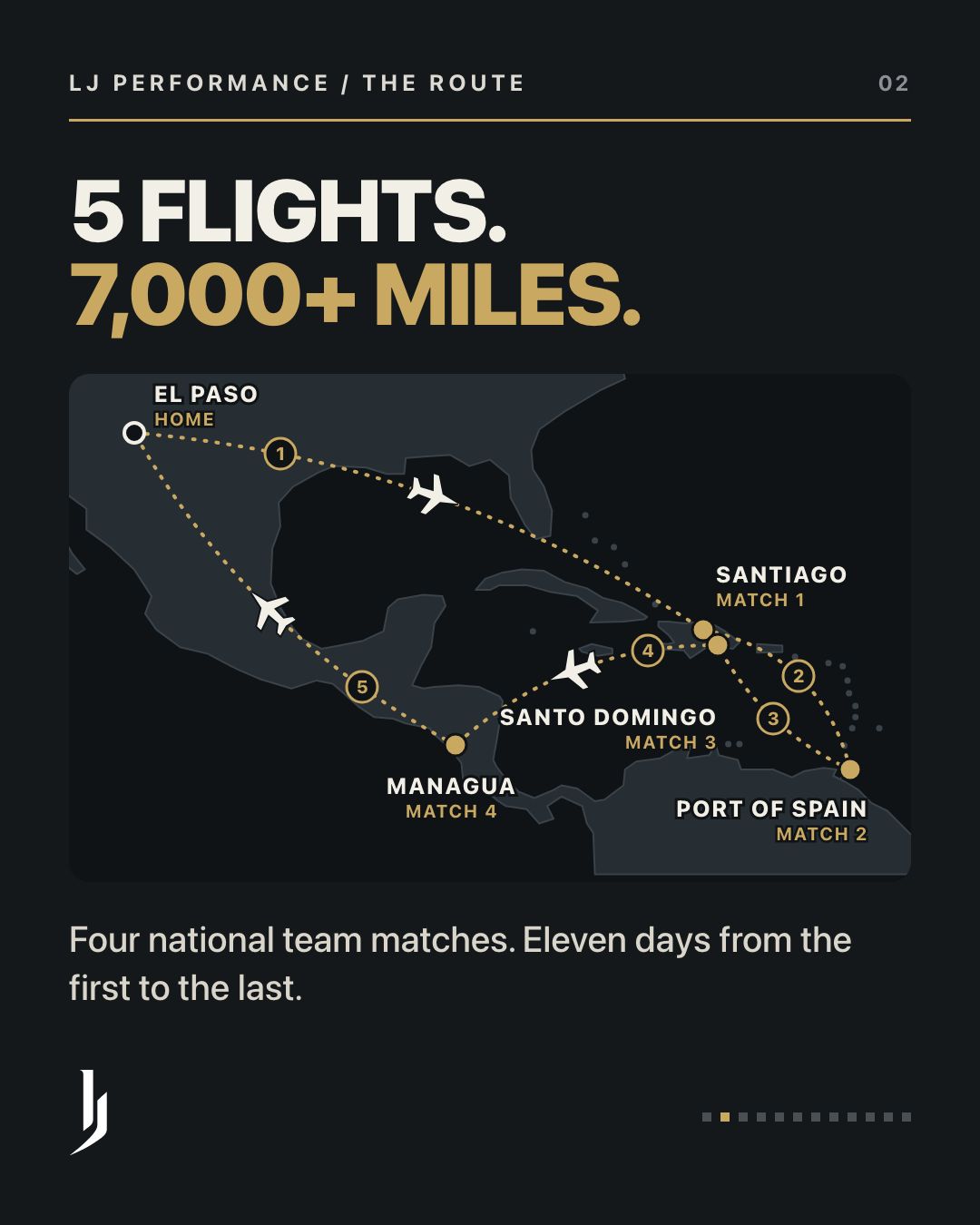
Five full matches in fifteen days. Four countries. Five flights. Sick for part of it.
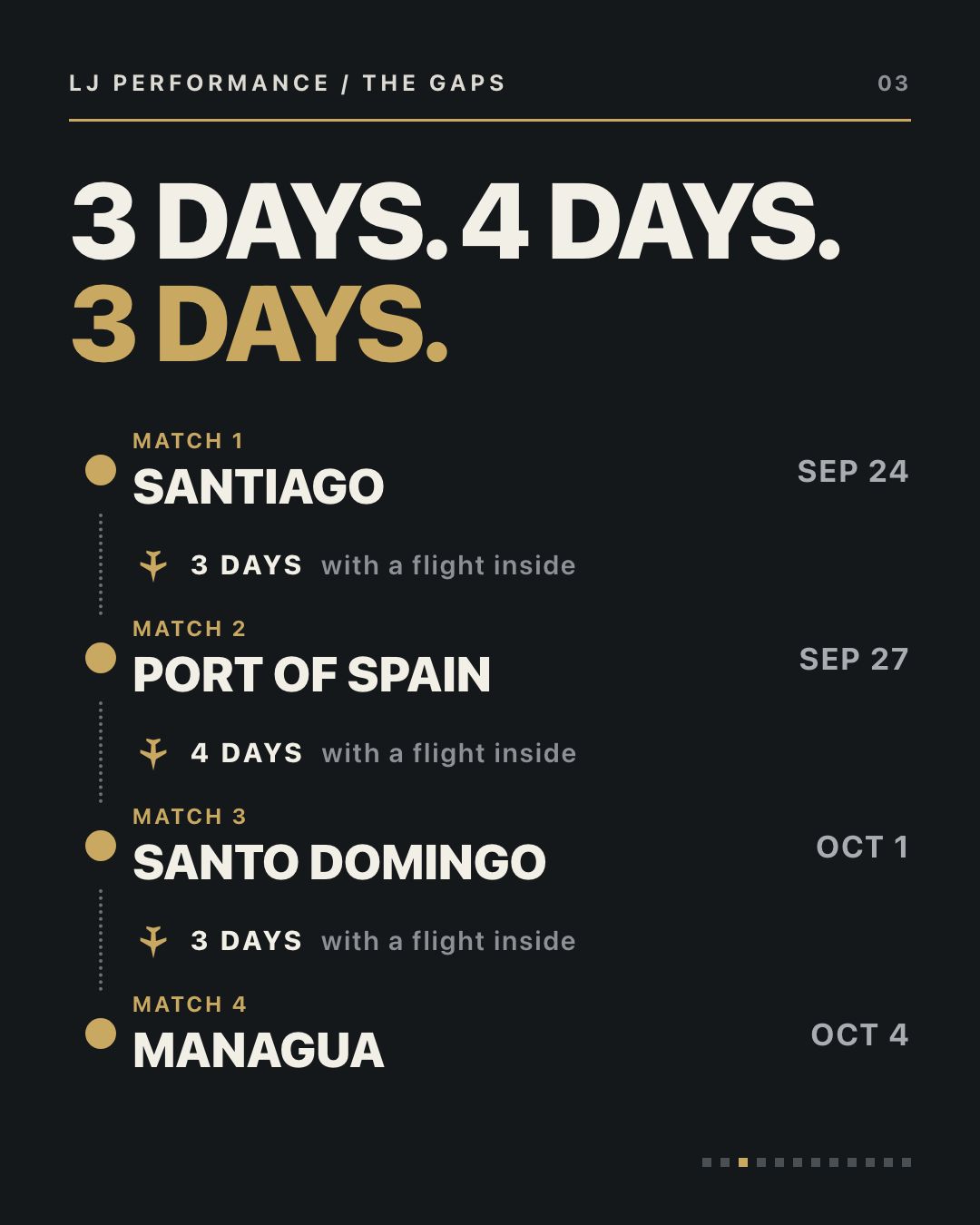
That was Noah Dollenmayer’s international window with the Dominican Republic. Noah plays for El Paso Locomotive in the USL Championship. Four of those matches were national team matches in the Concacaf Nations League, played in eleven days: Santiago, Port of Spain, Santo Domingo, Managua.
He finished it healthy and available for every match, and they won three of the four.
There is no room to train
People ask what the training looked like. The honest answer: very little.
The gaps between matches were three days, four days and three days, each with a flight inside. Push, and he carries fatigue into the next 90. Do nothing, and he loses the sharpness he arrived with.
In a window like this you don’t build fitness. You protect it.
Remember this: more is not always better. That is true for a pro in a FIFA window, and it is true for a young player with club practice, games and extra sessions stacked on top.
The players who keep improving are not the ones doing the most. They are the ones whose work has a reason behind it: why this, why today, and what it is building toward. If nobody can answer that for a session, it is worth asking before adding another one.
The plan was built before he got on the plane
Before Noah left El Paso, the whole window was already mapped in his app. Every match. Every flight. Every gap between them, and what each of those days was for.
He never had to wake up in a new city and wonder what today was supposed to be. When you’re playing every three days in a different country, at this level, one less decision matters.
Every day had one job
Match day. Recovery starts before he leaves the stadium. Cold tub, five minutes — minimum. He hates it, but he will hate it more if he misses a match due to injury.
One more rule for match day: I leave him alone. No check-ins. No questions. That day belongs to the match. Maybe a “Vamos!!!” or “LFG my guy I’ll be watching” but that’s it. Unless he wants to talk.
Day after. Flush the legs. Restore range. Get him moving after the flight.
The first job after a flight is simple: get outside and move. Easy. Then the rest of the work happens indoors, wherever he has landed.
Two days out. Keep strength switched on with a few short, intense isometrics with various muscle groups. No soreness added.
Each hold lasts seconds, not minutes. There’s enough intensity to prime him, enough volume to avoid fatigue, and intent from the buy-in and relationship we’ve built. Enough to remind the body what strong feels like, with nothing to recover from afterward.
Day before. Prime. Fresh. Stimulated. Just the right dose.
After every match. Check in. How are you sleeping, where are you sore, how’s your energy...
That is the outline. The rest was built for him, and it stays between us.
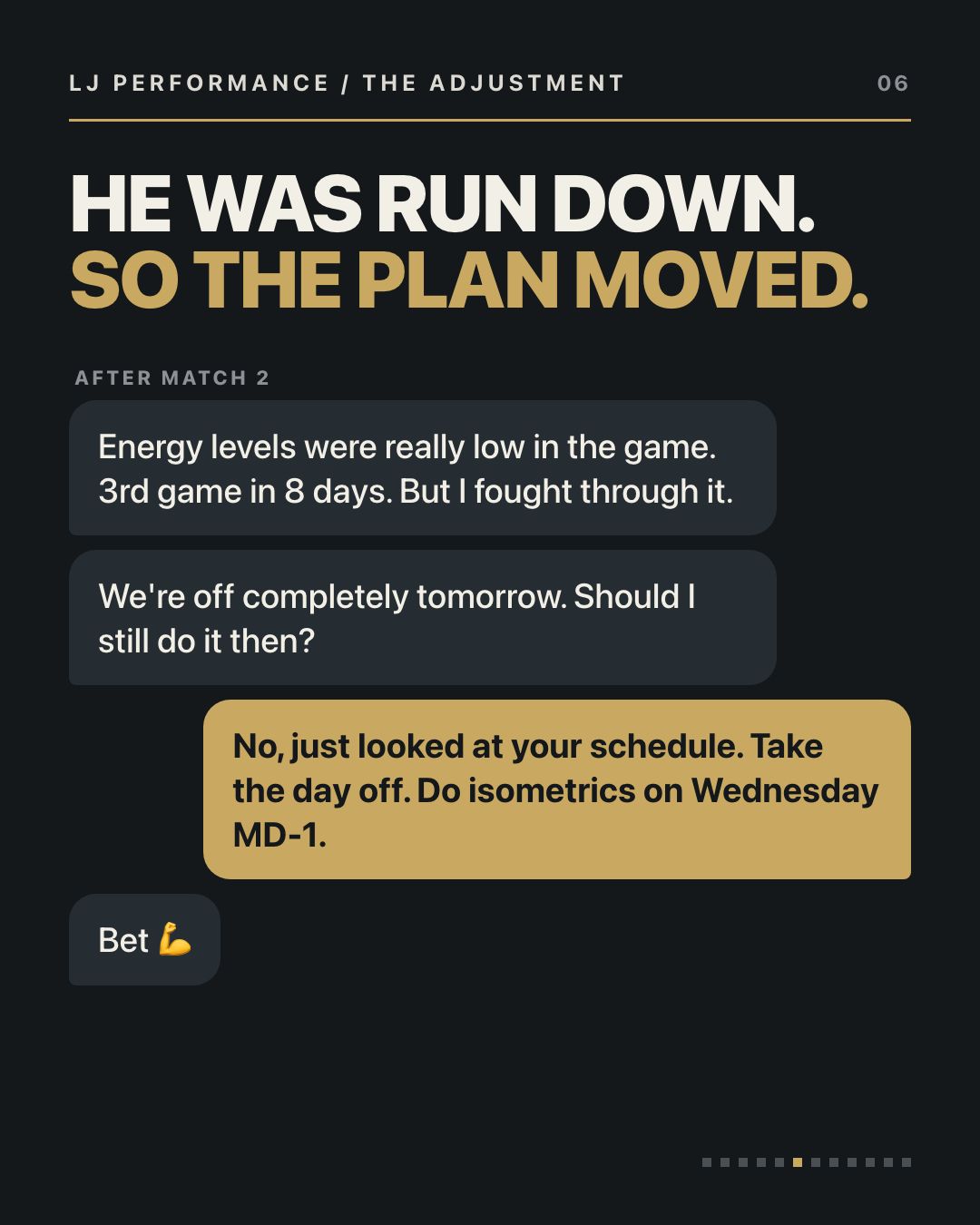
He was run down. So the plan moved.
After match 2, Noah texted me: “Energy levels were really low in the game. 3rd game in 8 days. But I fought through it.” He had a full day off coming and asked if he should still train.
My answer: “No, just looked at your schedule. Take the day off. Do isometrics on Wednesday MD-1.”
Another day in the window, his session was already waiting in his app. The exercises, the sets, the reps and the intensity were all there, built for that exact day. All he had to do was open it and follow it.
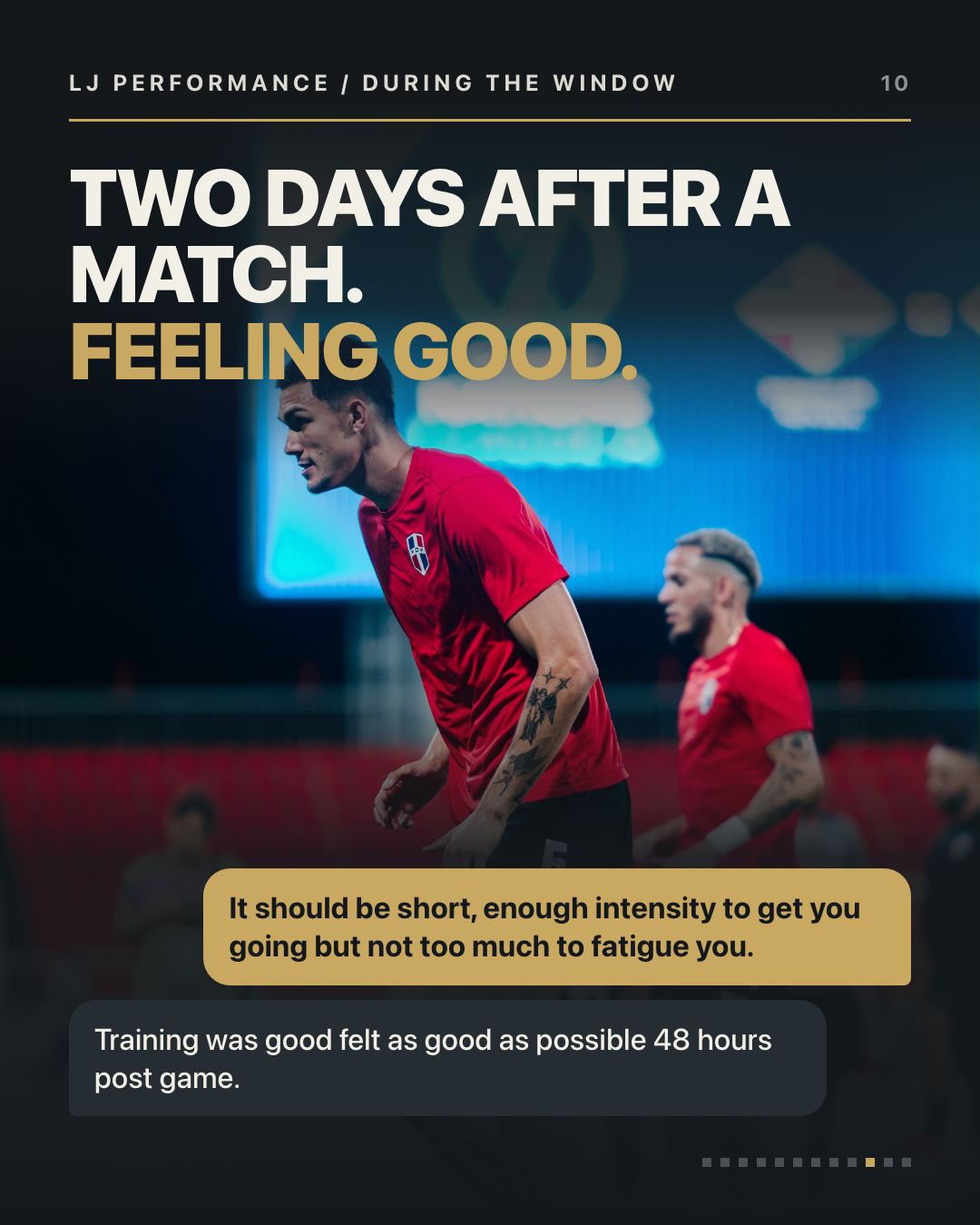
I guided him with how it should feel. It “should be short, enough intensity to get you going but not too much to fatigue you.”
His reply afterward: “Training was good felt as good as possible 48 hours post game.”
You have to know why, what and how to push
If all we do is rest, he loses the physical qualities he needs to handle what the match asks of him. Do too much, and he carries that fatigue into the next one, or into an injury. The right answer sits between those two, and it changes every day.
There is a science to it, and a level of precision and “feel”. Before I decide what a session looks like, I’m looking at:
The player. His history, how he responds, what he needs to feel ready.
The schedule and the travel. Days between matches and the flights inside them.
His position, and the minutes he has already played.
His team’s style of play. Playing as a winger in a 3-5-2 system versus a 4-4-2 yields a very different physiological and emotional demand. If you don’t take this into consideration, it will show. And that is not the player’s job. It’s the staff’s job to protect the player.
The opponent. Their style of play, and what that match is likely to demand from his position.
The matchup. Who he is likely to be up against individually.
And all of that is only one piece of it. The other piece doesn’t show up in any data: what is going on in his life, and how he is really doing. He has to be able to tell me he’s run down, and know that I’ll adjust the plan instead of pushing him through it. That’s where the relationship and trust piece comes in.
That is the part a plan on paper can’t do.
What I’m reading in the check-in
After every match, a short check-in lands on his phone. Sleep. Energy. Soreness. And a body map, where he taps exactly where it hurts.
When it lands depends on the week. Sometimes it is the day after the match (MD+1). Sometimes it is two days after (MD+2). Some weeks it is both. There is a case for each, and the travel, the turnaround and what I need to know decide which one we use.
Here is part of what he sees:
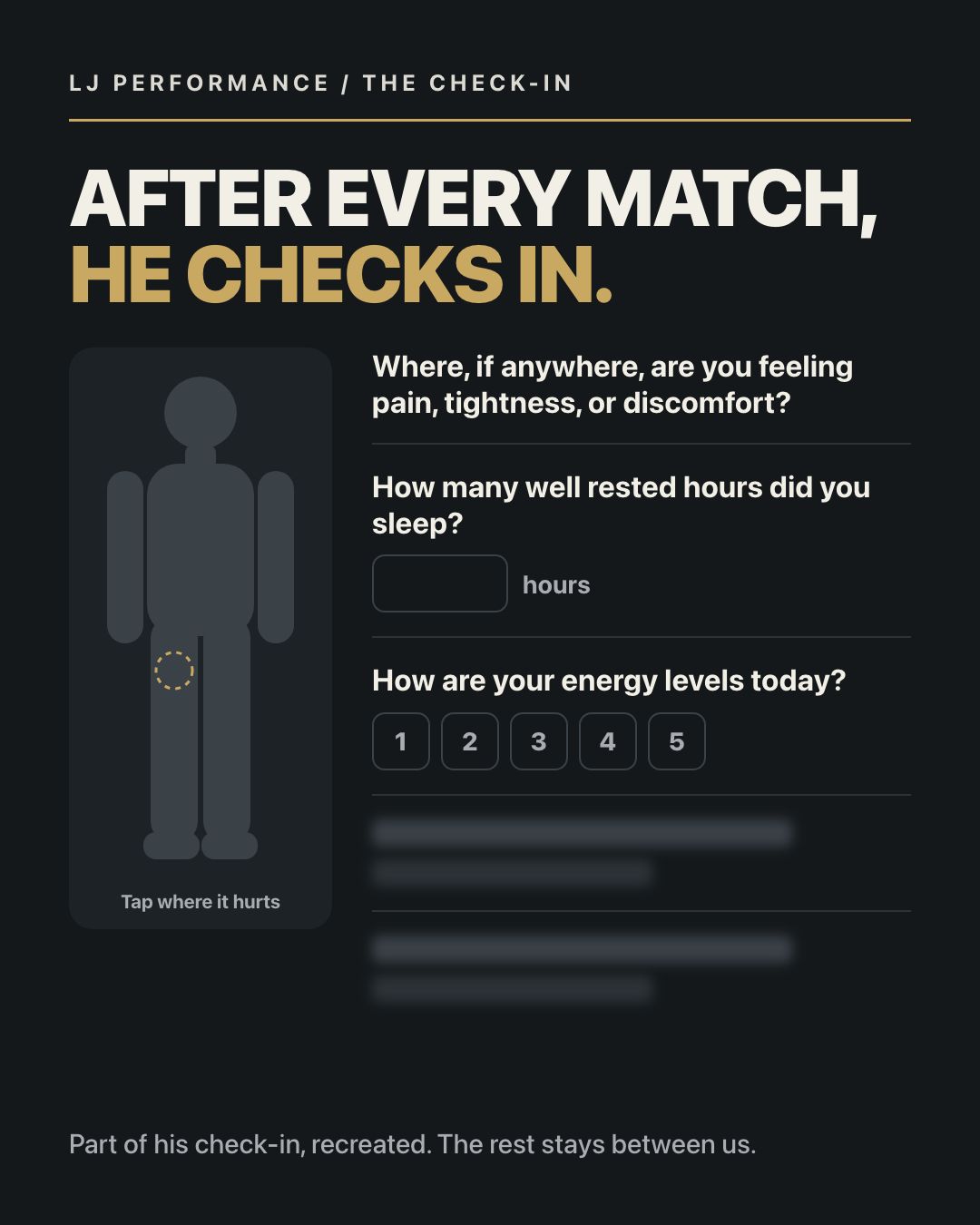
I’m not looking for one number. I’m looking for the pattern across matches. The same spot showing up twice. Sleep dropping while the minutes climb. That pattern decides what tomorrow looks like.
Some answers change the plan on the spot. Which ones, and what I change, is the part I keep for the players I work with.
Not in the same city. Still in his corner.
1. The plan lives in his app. Built around his match calendar, not a template.
2. He logs what he does. Travel-day routine logged after 3 of 3 flights.
3. He checks in after every match. Sleep, energy, soreness and a body map.
4. The plan moves when he does. Run down, sick or short on time, the session changes.
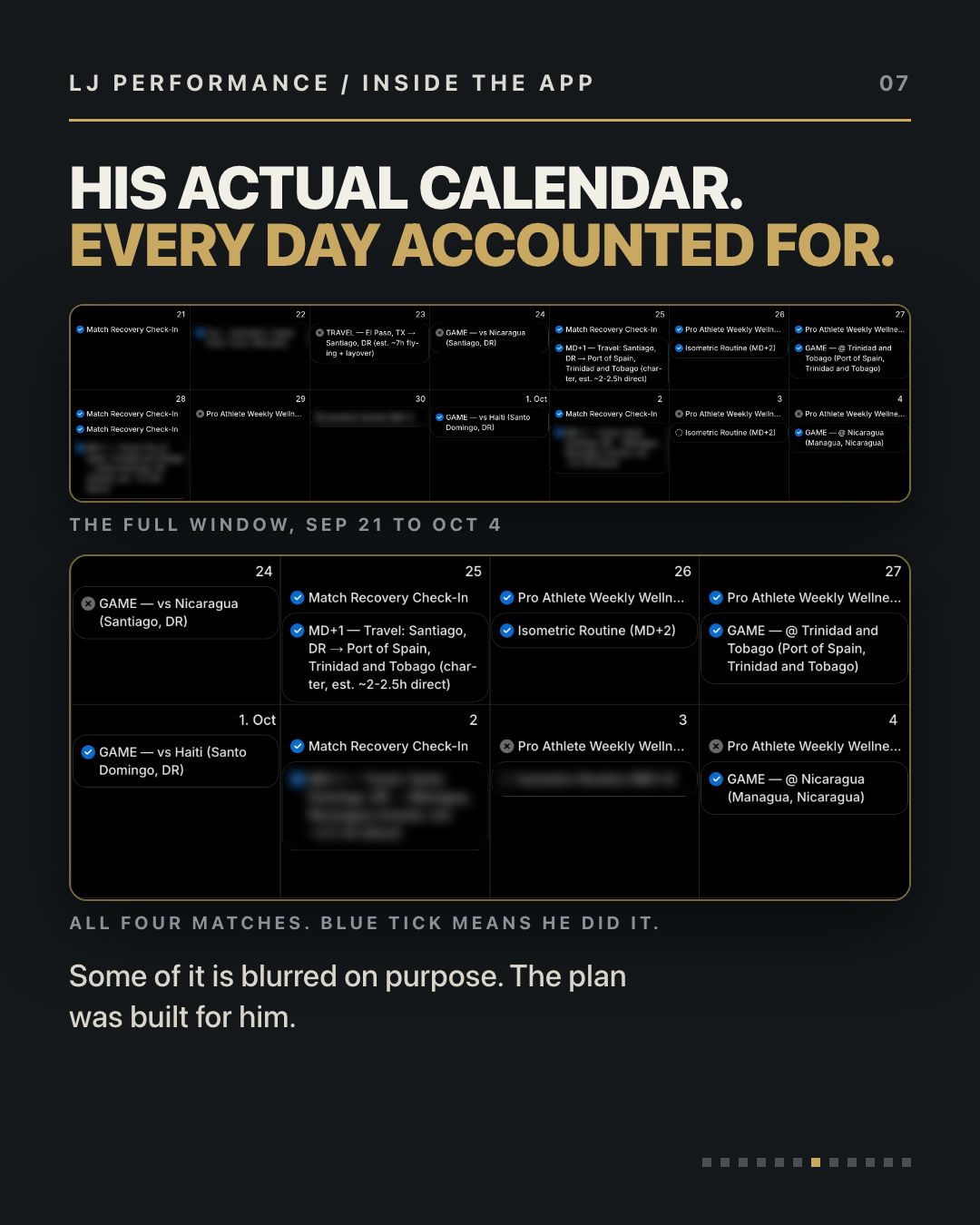
Credit where it belongs. Noah did the work. His club and national team staff ran his training. My role was the plan in between.
I spent years on the team side with 25+ players and one of me. That’s why I do this now. More on that this week.
Final whistle. My guy made it.
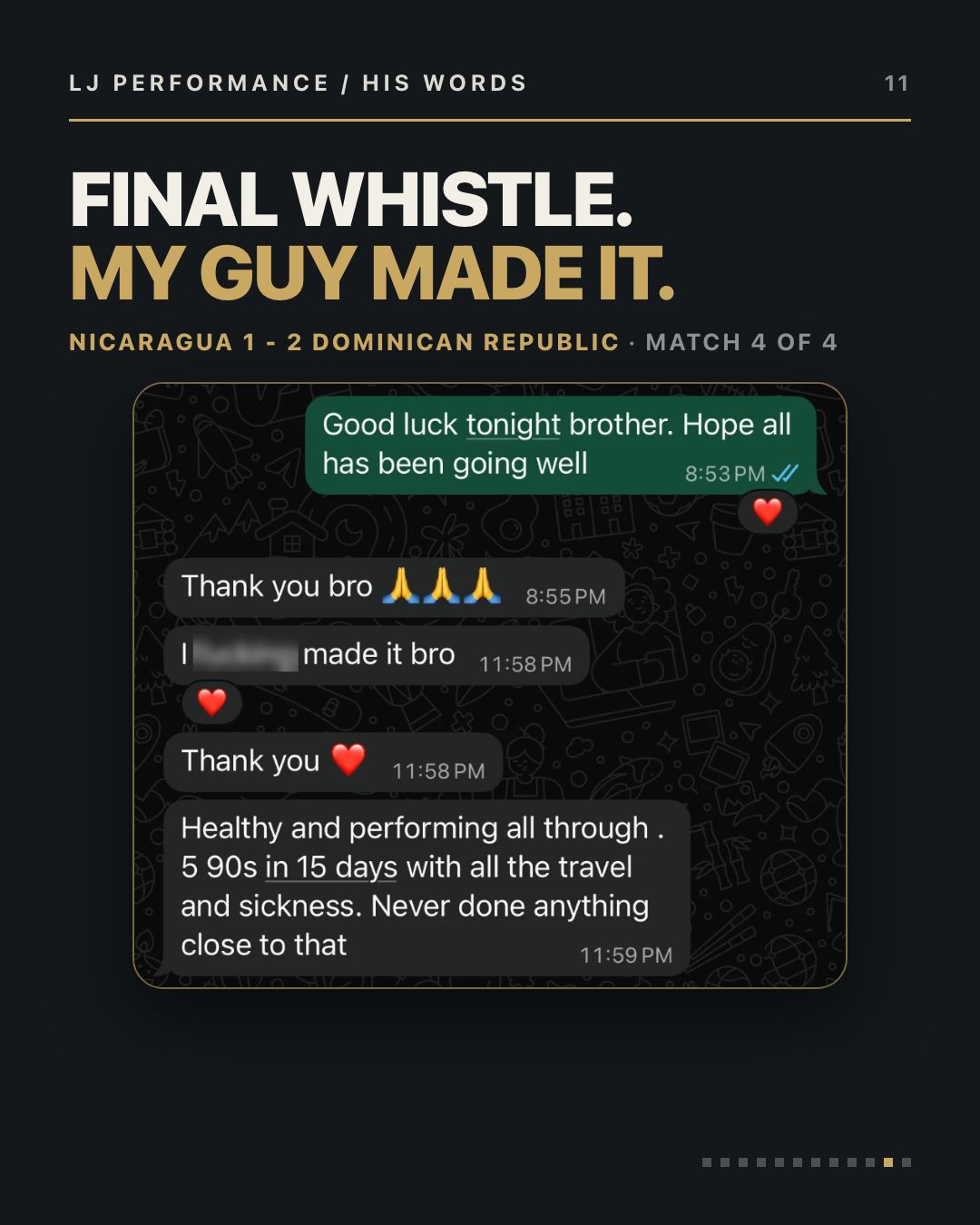
Nicaragua 1 - 2 Dominican Republic, match 4 of 4. At 11:58 PM, Noah texted me:
“Healthy and performing all through. 5 90s in 15 days with all the travel and sickness. Never done anything close to that.”
In-season support for pros, wherever you play
What you just read is the outline. The exercises, the doses, the travel-day routine, what I do when a check-in comes back bad: that is the work itself, and it gets built one player at a time, around one season.
If you’re a pro or heading that way and want to see what this would look like around your schedule, start here, reply to this email, or DM me “COACHING” on Instagram.
Youth players in Columbus: the same standard
This level of support is not reserved for pros. Here in Columbus, the players in our LJP Pro Academy get it too.
Check-ins and questionnaires in the app. Home workouts in the app for the days they are not with us. A plan that adjusts to how they are actually doing, not just what was written at the start of the month.
It is the same thinking you just read, scaled to a young player’s body, schedule and stage of growth.
Want your player trained like this? Come in for a free youth trial. Your player trains with us, you watch how we work, and you see the standard for yourself before you commit to anything.
Spots are limited and capped by coach availability.
Luis

Luis Jeronimo, MS, CSCS | Founder, LJ PERFORMANCE
Luis Jeronimo is a High Performance Coach, consultant, and innovator who has operated at the highest levels of sport - from Olympic programs, to the private sector working with some of the most elite athletes in the world, to multiple MLS clubs. He is the architect behind the performance systems and winning cultures those organizations have run on.
Today, he runs LJ PERFORMANCE in Columbus, OH, with one mission: to demonstrate what true high performance in soccer looks like, by fusing elite-level performance, recovery, technical, tactical, and holistic methods drawn from his time at the highest levels of sport, building a unique standard the next generation of athletes will train by.
That same standard, the systems, monitoring, and coaching used with professional athletes, is what every athlete at LJ PERFORMANCE trains under.